Skip to content
Talk to us
Brands

A passport that answers for your product, long after the sale.

Recyclers, insurers, second-hand buyers, repairers, market authorities: your product will meet them all one day. Publish the record once, and each of them gets a trustworthy answer without needing anything more from you.

Nothing here asks to be believedEvery claim on this page routes to something you can open and run: a record, an anchor, a resolver we do not operate, a published key.Start with the public check →
START WITH YOUR SECTORThe obligation, the field set, and what is running today. One of these three is a legal deadline; the other two are not, and we say so.

A sector here is a field set in the standard’s registry, not a separate product. The record model, the checks and the anchoring are identical across all three, which is why a provider implements once and covers every sector.

01Who actually reads it

A product outlives the sale and the relationship. The people who need the record later are the ones you never onboarded.

02Why permission breaks it

If checking needs an approval, a brand server or a consortium membership, it fails exactly when it is needed. A permissioned ledger only moves the gatekeeper. Products outlive companies.

03What that forces

Anyone verifies, from public data, forever, with nobody to ask. That is public infrastructure, not a database behind an API with a code in front of it.

A standard, not a platform

We are building the DPP standard on BSV. This site is the demonstration of it.

Rules anyone can build on, not a product we own. No service and no frontend is mandatory, including ours.

What is being builtA standardIt defines how product passport records and services must behave: a published specification, a conformance test suite anyone can run, and a reference implementation proving it can be built and operated. That work is in progress.
The demonstration, blurred on purposedpp.bsvb.net is a working demonstrationLive records, real identities, passport identifiers in GS1 Digital Link format. It is not the standard and not a final commercial product. Standard, services and frontend are developed together on purpose, so the whole flow can be tested and each piece teaches us which layer it belongs in. Once the standard is final the layers separate.
01Providers build on top, including competitorsApplications and services around the same records: our own products, another provider’s platform, or the workflow you already run. The standard is the only thing they share.
02No vendor lock-inA brand’s history belongs to the record, not to whoever hosted it. Costs are fixed and tiny, and records outlive any supplier.
03Consumers get one answerOne scan, the same verifiable result wherever they scan it, checkable in their own browser, nobody’s permission needed.
04The network gains as a wholeEvery passport, event and attestation is a transaction on a public blockchain. A standard others adopt becomes sustained activity on it, which is why this is built in the open rather than kept.
One record per unit, whoever builds the application
ModelOne page for every unit ever made. Most passport products stop here.
BatchA production run shares one record. Closer, and still not the unit in someone’s hand.
ItemA serialised GS1 Digital Link per unit. The standard starts here, so every application built on it inherits it.
The deadline

Batteries first, then the rest by delegated act.

Four dates, each with the instrument that sets it. Scope matters more than the date: the battery obligation is narrower than the headlines suggest.

18 July 2024In forceThe framework enters into forceEcodesign for Sustainable Products sets up the product passport as an instrument. It obliges nobody on its own: each product group is bound later, by its own act.Regulation (EU) 2024/1781
April 2025AdoptedThe first working plan names the queueThe Commission’s first plan under the framework sets which product groups are worked on and in what order, through 2030.ESPR working plan 2025 to 2030
18 February 2027The first hard obligationThe battery passport becomes mandatoryFor electric vehicle batteries, light means of transport batteries, and industrial batteries above 2 kWh placed on the EU market. Each unit needs its own passport, reachable from a code on the battery.Regulation (EU) 2023/1542, Article 77
2027 onwardsExpectedTextiles and the rest, group by groupEach delegated act carries its own date, scope and field list. Until one is adopted for a group, nothing in that group is obliged, whatever a vendor’s countdown implies.Per delegated act, not yet adopted

We do not sell a compliance guarantee, and no product can. What we build is aligned with these instruments, and every date above names the one that sets it so you can read it yourself.

What the record carries

The fields come from the standard, not from a form we invented.

Each sector has its own field set in the registry. The battery set is the one running today.

The identifierThe code you print is already the address.

One barcode, and no app to install. A phone camera opens it, and a retailer, a market authority or a recycler resolves it with the tools they already use, in any market that follows the same standard.

The standard also allows a batch segment between the two. We go straight to the unit, because a passport for a production run is not a passport for the item in someone’s hand.

id.gs1.org/01/09506000134352/21/7E4D3D750361
01The modelWhich product this is. Shared by every unit of it.21This one unitThe serial number. One record, one physical object.
The model number above is GS1’s published example code, shared by every record in this demonstration. Your own is allocated by GS1, not by us.
Battery passport, the running field setbattery@2Derived from DIN DKE SPEC 99100, cited by clause
ChemistryCell composition and the substances of concern in it.
State of healthCapacity against original, cycle count, updated over the life.
Carbon footprintDeclared per unit, with the method that produced it.
Recycled contentShare per material, cobalt, lithium, nickel, lead.
Due diligenceThe supply chain policy statement the regulation asks for.
Our mapping of these fields to the specification’s clauses is under review and not yet signed off. We say aligned with, never compliant, and we cite the specification rather than reproducing it.

The textile and general field sets work the same way: an entry in the registry, with a citation per instrument where one exists. Adding a sector is a registry change, not a new product.

How you publish

Three steps, and nothing leaves your hands until you press register.

The reader’s side is on the home page. This is the maker’s side, and it is short.

01Start a brand

Name it, pick the sector, and the brand’s identity is created for you. No integration call, no sales stage in between.

SectorBatteryTextileGeneral
02Fill the form the standard wrote

The fields, their units and their validation come from the sector’s registry entry. When the registry gains a field, the form gains it too.

Nominal capacity78.4kWhRecycled cobalt16%
03Register, and it is live

Nothing is published until you press it. After that the record is public, permanent, and readable by anyone with the code, including people you will never meet.

Time to first live recordMinutesCost per recordFixed and tinyPriced per monthNo
Something to hand over

A certificate of record, for the file that needs a document.

Customs, an insurance claim, a resale listing, an auditor who wants a PDF. Any record can produce a signed, dated copy of itself, and it is honest about being a copy: the record continues after the date on the page, so the code on it goes back to the live state.
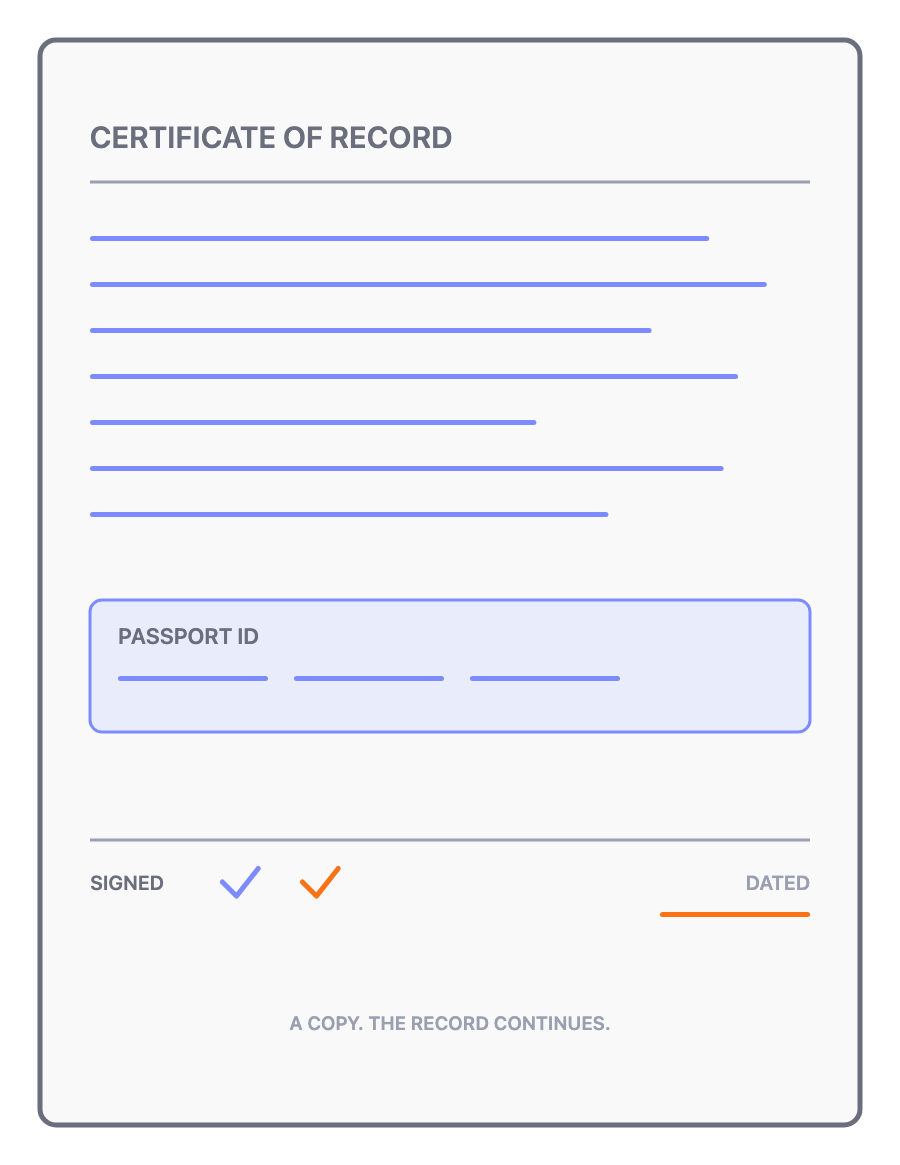
SIGNEDBy the brand that authored the state, then countersigned by the platform that recorded it.
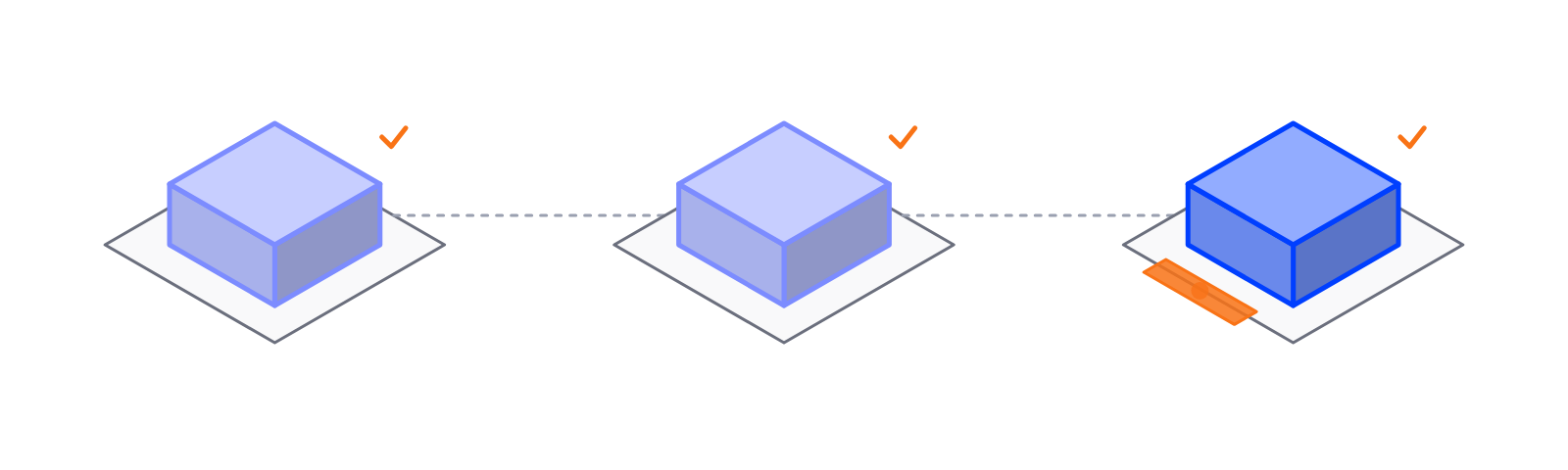
THREE HOSTSIt prints the same passport identifier as answered at this platform, at GS1’s own resolver, and at an anchor viewer reading from a block explorer. Only the host changes, so nobody has to trust one of them.
PORTABLEA file, not a login. It keeps working when the internet, this platform or this company is not there.
Specimen for a sample product. Every record can produce one.
Read this before you commit

What we are not claiming yet.

Six limits, in our own words, before an evaluator finds them. A record that volunteers what it cannot prove is worth more than one that does not.

We hold your key todayEvery brand identity names this platform as its controller. You cannot yet update your identity or take it elsewhere. The design that hands the key to the brand is agreed and unbuilt, so today you are a tenant here rather than a peer.
The standard is not published yetThe record model and the rules are written and the repositories are private. Until they are public, a standard anyone can build on is a description of intent, and an adopter would have to take the source from us.
Nobody outside the team has run the checkThe public check works and the recipes are published, but every run of it so far has been ours. We are not quoting outside validation, because there is none to quote.
The identifier is GS1’s example codeRecords here share GS1’s published example product code, which is not allocated to any brand. Resolution through GS1’s own resolver is real. Your own allocated code is something you obtain from GS1, not from us.
Only we vouch for a brandNo outside body has tied any brand here to a legal entity you could look up elsewhere. The record says so on its own face, and names the slot a certifier would fill.
Carriage as a UNTP credential is started, not doneWork is underway and the specification it aligns to is itself pre-1.0. Aligned with, never compliant, and never in the past tense until it is finished.

Publish one record and check it yourself.

Start a brand, register one product, then run the public check on it the way a market authority would. What you register is kept, and stays labelled as a demonstration.