
Proof that does not depend on us.
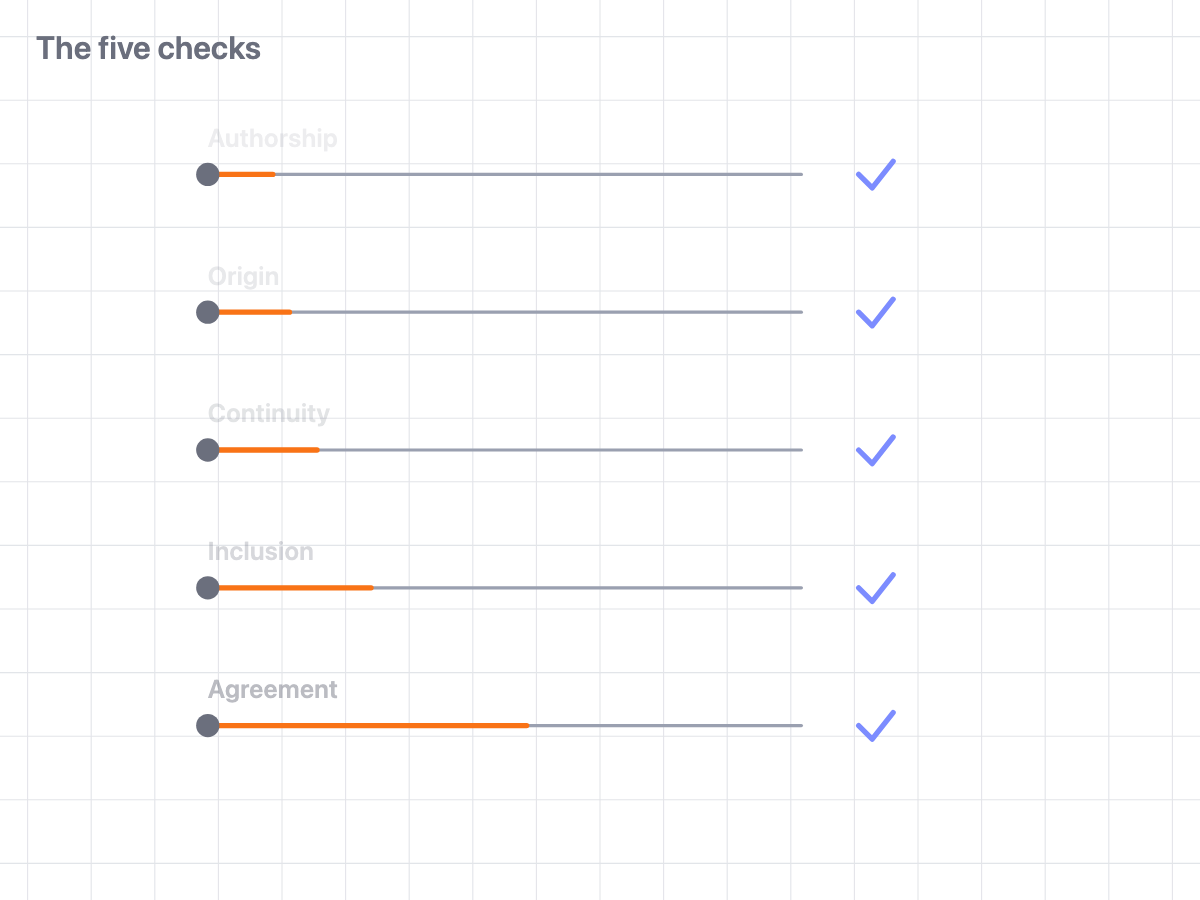
Five checks run in your browser. Two of them go to sources we do not control, which is what makes the answer worth anything.
One source of truth, told three ways.
A passport is written to once at manufacture and added to at every stage after it: sale, service, repair, resale, recycling. Any application can read it at any of those stages. These three are unrelated and reach the same answer.
Submit the identifier in any of them. The same path resolves at each product’s own host.
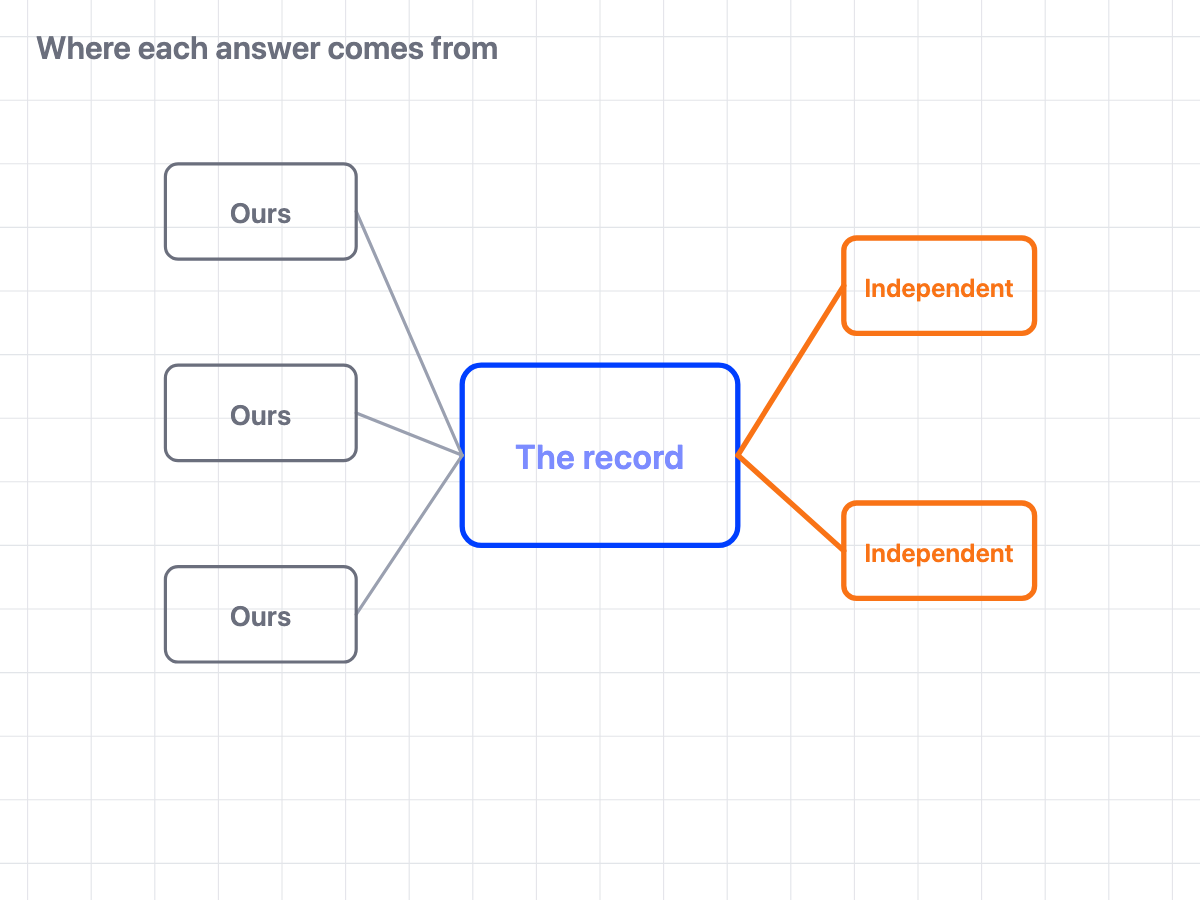
Two lanes, and only one of them is ours.
A check that only asks its own author proves that the author is consistent, and nothing else. Two of the five go to services we do not run, so the result holds even if you assume the worst of us. These are separated so you can see which did what.
All three are ours. They are how you find and read the evidence, not confirmation of it. The independent part is the comparison against a public explorer and the header check behind a proof; anything stronger means running the published recipes yourself.
The technology doing the work, one paragraph each.
The BSV blockchain
Every entry is written as a transaction on a public blockchain: a permanent, timestamped record that anyone can read and nobody, including this platform, can quietly edit afterwards.
Digital signatures
A signature is a number only the holder of a private key can produce, and anyone with the matching public key can check. It turns "someone claims" into "this key approved".
Key derivation
Each record is signed with a key derived from an identity key and that record's own identifier, so a signature cannot be lifted off one record and pasted onto another.
Decentralised identifiers
A DID is an identifier that resolves to its own public key document, with no central registry to ask and no permission to request. This platform publishes its signing identity as one.
Overlay network and lookup service
An overlay network indexes only the transactions belonging to one scheme and answers questions about them, such as which entries exist for a product. Finding records does not depend on this website staying up.
BEEF, the bytes you were handed
BEEF is a package format that carries a transaction together with the transactions it spends and the proofs for them. The index hands the whole package over, which is what makes it possible to check the record in your browser rather than trusting a server to have checked it.
Block explorers, such as WhatsOnChain
A public service that lets anyone read any transaction on the blockchain by its identifier. It is run by somebody else, so asking it the same question again is how this page gets a second opinion on what we handed you.
Hashes, digest anchoring and SPV
A digest is a short fingerprint of a document. Committing it to a transaction dates the document without publishing it. When an entry carries a Merkle proof, this page checks it against public block headers.
Check a product yourself, right now.
No account, no sign-up, and nothing to install. Paste any passport ID and watch the five checks run in your own browser, against sources we do not control.